Chill Route Compass
An in-cab telematics companion that keeps cold cargo safe
- Role
- Lead Product Designer
- Timeline
- 2026
- Tools
- Figma, Prototyping, Usability testing
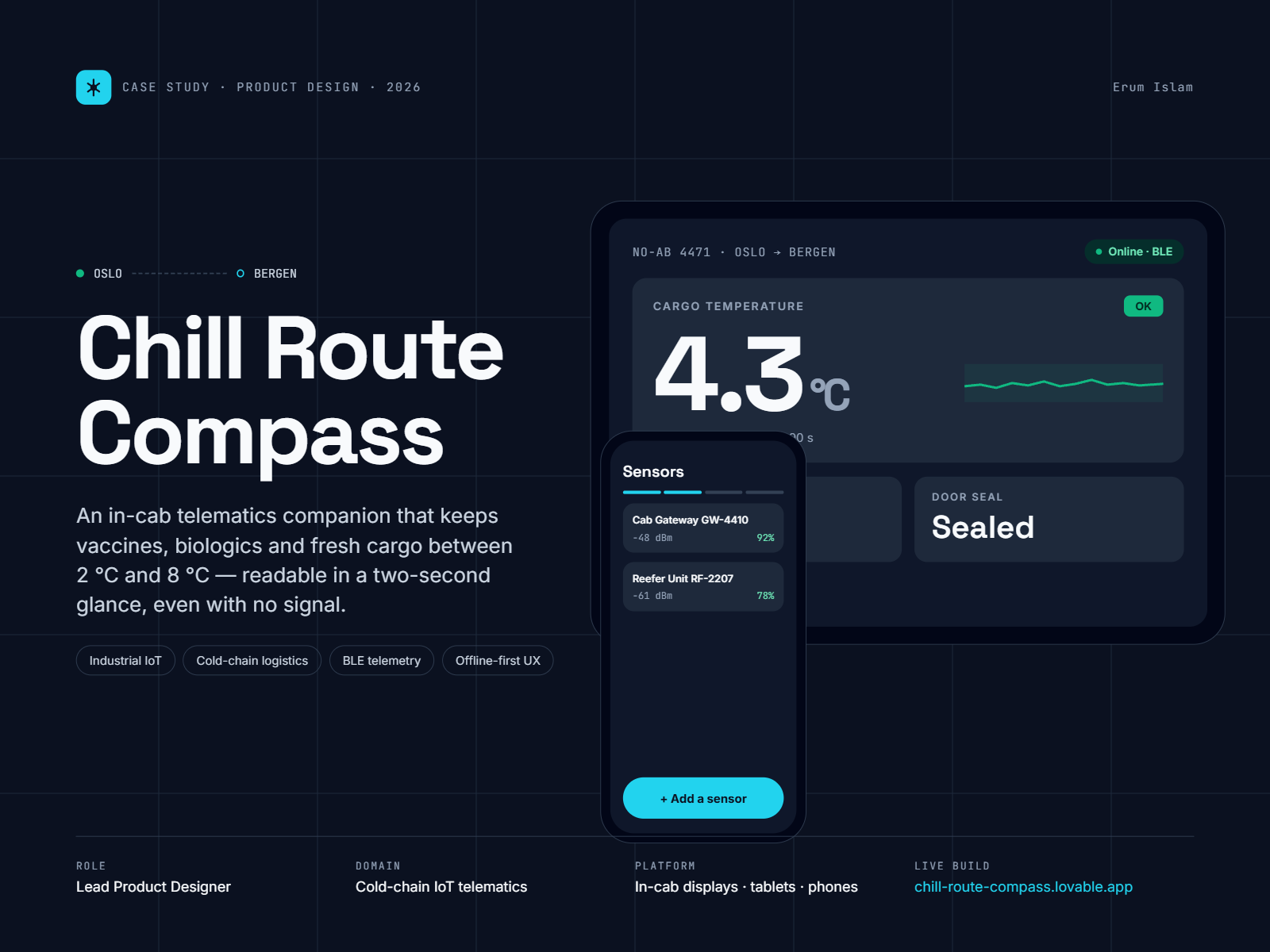
Chill Route Compass is an in-cab telematics and cold-chain IoT companion for heavy freight. It keeps vaccines, biologics and fresh cargo between 2 °C and 8 °C — readable in a two-second glance, even with no signal.
The problem
One failed reefer unit. One loose latch. A spoiled shipment in under an hour. Refrigerated cargo must stay between 2 °C and 8 °C, a single shipment can be worth over $100k, and drivers have no time to dig through complex software while on the road.
- 2–8 °C — the narrow safe range for vaccines, biologics and fresh cargo.
- $100k+ — the value of a single spoiled shipment.
- < 1 h — the time it takes for cargo to leave the safe range.
Design principles
Software that behaves like part of the truck.
- Bulky hardware and interface — built for gloves, glare and vibration, not a desk.
- The 2-second glance rule — a driver confirms cargo safety without reading a sentence.
- End-to-end IoT companion — from BLE sensor pairing to in-transit monitoring.
- Decoupled environment pods — temperature, humidity and door seal read independently.
Design process
From cab conditions to a live build, in four steps.
- Empathize & discover — riding along to understand real cab conditions.
- Define constraints — gloves, glare, dead zones and two-second glances.
- Low-fi wireframing — visual weight first, styling later.
- High-fi & prototype — a live, testable build on real hardware.
The in-transit hero telemetry monitor
- Hero typographic readout — the cargo temperature dominates the screen.
- Rolling 60-second sparkline — trend at a glance, no chart-reading required.
- Decoupled environment pods — humidity and door seal sit beside the temperature.
- Persistent connectivity pill — Online · BLE status is always visible.
BLE pairing and pre-trip diagnostics
- Hardware-first modular cards — each sensor (cab gateway, reefer unit) gets its own card.
- Pre-trip live graph — signal strength and battery confirmed before departure.
- High-confidence action zone — one clear primary action per screen.
- 4-step setup stepper — pairing a new sensor takes under a minute.
When thresholds break, the interface changes mode
A breached threshold turns the whole interface into an alarm state — no hunting for what went wrong.
- Cognitive triage — the problem, the cause and the action, in that order.
- Noticeable 3-step protocol — check door seal, verify reefer unit, silence when resolved.
- Fail-safe press-and-hold — alarms can't be dismissed by an accidental tap.
Tested where it will be used: in the cab
Testing happened in real cab conditions — direct sunlight glare, thick work gloves and mountain dead zones — and the interface held up: glance time under two seconds, zero cloud dependency, and one-to-one parity with the hardware sensors.
Outcomes
- < 2 s glance time — drivers confirm cargo safety without stopping.
- 0 cloud dependency — offline-first UX keeps working through tunnels and dead zones.
- 1:1 hardware parity — the interface mirrors the physical sensors exactly.
